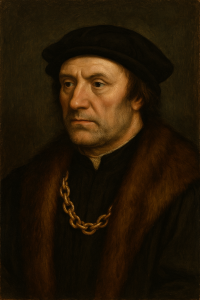
Princes Murdered in the Tower: Sir James Tyrell and the Chain of Office of Edward V
18th September 2025 by | UncategorizedSir James Tyrell’s name has long been linked to the fate of the Princes in the Tower. Tudor writers, decades after the events, claimed he confessed to arranging their deaths. Yet no original record of such a confession survives. Tyrell was executed under Henry VII in 1502, and only after his death do stories of his supposed admission begin to appear — raising doubts about their reliability.
Far more compelling than these late Tudor accounts is the survival of documentary evidence. In 2024, Professor Tim Thornton uncovered a will made in 1522 by Margaret Capell. In it, she left to her son Sir Giles Capell “his father’s chain, which had once belonged to the young King Edward V.”
The meaning is precise: the chain had once belonged to Edward V. It later passed into the hands of Sir Giles’s father, Sir William Capell, and by Margaret’s will was handed on again to their son. This was no trinket of personal jewellery but a chain of office — a symbol of the boy king’s dignity and status.
The significance lies not only in the nature of the object, but also in the family who preserved it. Margaret Capell was the sister-in-law of Sir James Tyrell. This connection was forged through marriage between the Arundell and Tyrell families: Margaret’s sister, Anne Arundell, was Tyrell’s wife. In other words, the Capells were directly linked to Tyrell by blood and marriage.
The appearance of Edward V’s chain of office in this household raises profound questions. How did the Capell family obtain it? From whom did it pass, and under what circumstances? Was it seized, gifted, or quietly taken after the princes’ disappearance? The record does not say — and therein lies the mystery.
The discovery does not give us final proof of what happened in the Tower, but it provides something Tudor propaganda cannot: a tangible, named relic. An emblem of Edward’s kingship, preserved in a will a generation later, linking his lost life to families bound to the man later accused of his death.
This is why modern science is urgently needed. DNA testing could provide conclusive answers. Until then, the chain of office remains one of the most striking fragments of truth: a reminder that the Princes in the Tower were not only figures of myth, but real children whose possessions and legacy still cast long shadows of uncertainty.