Mary Tudor
14th May 2026 by | Uncategorized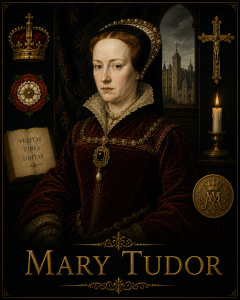
Meet the characters in my novel, The Wolf of Whitehall, Mary Tudor
History has not always been kind to Mary I of England.
She is often remembered by a single name, one that has come to define her in ways that feel both immediate and incomplete. Yet to understand Mary Tudor is to look beyond that reputation, and to consider the life that shaped it.
She was the daughter of Henry VIII and Katherine of Aragon, raised within a court that would later cast her aside. Declared illegitimate, separated from her mother, and forced to navigate a world that shifted beneath her, Mary’s early years were marked not by power, but by uncertainty.
It is within that experience that much of her character was formed.
When she came to the throne in 1553, it was not through quiet succession, but through resolve. Her claim was challenged, her position far from secure, yet she moved decisively, gathering support and asserting her right to rule.
She became England’s first queen regnant.
Her reign would be shaped by conviction — most notably in her determination to restore the Catholic faith. It is here that her legacy has been most fiercely debated, and where history has drawn its sharpest conclusions.
Yet Mary Tudor was not a figure of simplicity.
She was a woman shaped by loss, by faith, and by a profound sense of duty to what she believed was right. Her actions, however judged, were rooted in a belief that she was restoring truth, not imposing it.
In the wider story of the Tudors, she stands as a figure of transition — between the worlds of her mother and her sister, between two religious landscapes, and between differing visions of England’s future.
She is remembered for her reign.
But she is perhaps better understood through her resolve.
The Wolf of Whitehall