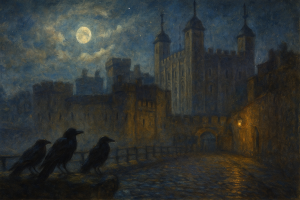
Two young princes vanished from the Tower of London in 1483 — their fate remains one of England’s most enduring mysteries.
17th September 2025 by | UncategorizedMy fascination with the case began when I was eight years old, standing beside the Thames on my first school trip. Having come from Kent’s fields and farms, the Tower’s ancient stone walls left a lasting impression. Even now, I believe there is no building in England more capable of inspiring the sense of a haunting presence than the Tower itself.
My website and petition, Murder in the Tower, take their name from that sense of uncanny history. While the Tower has been the setting for numerous executions and acts of brutality, it also witnessed events that remain woven into the fabric of our national story — in particular, the disappearance of Edward V and his brother, Richard of York.
Let us step back to spring 1483. King Edward IV had reigned for nearly thirty turbulent years. He had ascended the throne at eighteen after the bloody Battle of Towton, fought in relentless snow where thousands perished. The Wars of the Roses spared no one—not even royal brothers. Edward signed the death warrant for his brother George, Duke of Clarence. Legend holds that George was drowned in a vat of Malmsey, and there persisted whispers that Richard, Duke of Gloucester, might have been involved.
Edward’s eldest son, Edward V, aged twelve, was living at Ludlow Castle to prepare for kingship. His younger brother, Richard of York, aged nine, remained in London at Baynard’s Castle with their mother and sisters. Then, in April 1483, Edward IV died unexpectedly, leaving a kingdom under the guardianship of his brother, Richard of Gloucester — a man who had loyally served the crown through blood and betrayal.
Soon after, questions arose about the validity of Edward IV’s marriage to Elizabeth Woodville, based on an alleged pre-contract with another woman. If true, all of Edward’s children were illegitimate, clearing the way for Richard. The princes were taken to the Royal Apartments in the Tower of London for “their protection”, but later moved to the Garden Tower — today known as the Bloody Tower — where they disappeared from history.
Sir Thomas More recorded their disappearance with haunting clarity. One curious clue survives: Edward’s chain of office — a lifelong emblem of kingship — surfaced in the will of a member of the household of Sir James Tyrell, a close associate of Richard. The connection rings with possibility.
In 1674, workmen rebuilding a staircase in the White Tower unearthed a wooden box containing a selection of human bones, fragments of fine cloth, and rusty nails. Believed by some to be the princes’, the remains were placed in an urn and buried in Westminster Abbey as ordered by Charles II — but without any modern scientific examination.
On 6 July 1933, the urn was opened under the oversight of the Dean of Westminster, Professor William Wright, and Lawrence Tanner, archivist. They discovered partial remains of two children — skull fragments, jawbones, thigh bones — mixed with animal bones and nails. By 11 July, after examination, the remains were respectfully returned to the urn and interred once again. No further study has been conducted to date.
As both historian and mother of two boys, I feel these young princes, if truly there, deserve a dignified resting place beside their parents in St George’s Chapel, Windsor.
I am campaigning for DNA testing under Westminster Abbey’s Royal Peculiar status, which gives King Charles III the authority to approve such work. I have spoken with the forensic professor who oversaw the Richard III project, and she would guarantee dignity and professionalism.
This campaign does not serve to assign blame. It serves to bring clarity to a centuries-old mystery using today’s best tools. My forthcoming novel, Murder in the Tower (due summer 2026), brings the summer of 1483 to life with researched detail and fictional depth.
I warmly invite readers of The Writing Desk to join this quest for truth. Please visit www.murderinthetower.london to sign the petition. Each signature honors the memory of two young boys and our collective urge to understand our past.