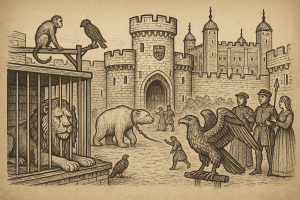
The Royal Menagerie at the Tower of London.
23rd September 2025 by | UncategorizedGood morning,
With my first novel due for publication next month, I have been sharing posts to introduce you to some of the characters who bring its pages to life. Yet it is important to remember that people alone do not tell the whole story. The houses, palaces, artworks, ships, and remarkable objects of the age also fill the world of my book, helping to reveal Tudor England in all its richness.
In that spirit, let me introduce you today to one such marvel: The Royal Menagerie at the Tower of London.
Long before it became a place of execution and imprisonment, the Tower of London astonished visitors with its living trophies of empire. The Royal Menagerie began in the thirteenth century, when Henry III received gifts of lions and leopards from the Holy Roman Emperor, and an elephant from Louis IX of France. By the time of the Tudors, the Tower’s beasts were as famous as its dungeons. Records tell of a polar bear, gifted by the King of Norway, tethered by a chain and led daily to the Thames to fish for its supper. Lions roared in iron cages, while monkeys capered in wooden pens. Eagles and owls were tethered near the Lion Tower, their cries carrying across the bailey.
For courtiers and foreign envoys, the menagerie was a theatre of power, demonstrating England’s place in a network of diplomacy and gift-exchange. For common visitors, admitted by special leave, it was a glimpse into the marvels of a wider world. Tudor chroniclers describe the animals with awe, but also as emblems: the lion for courage, the bear for ferocity, the leopard for swiftness. The menagerie endured into the eighteenth century before its animals were moved to the new Zoological Gardens. Yet in the Tudor imagination, the Tower’s lions and bears were every bit as iconic as its stone walls.