The Mary Rose
24th September 2025 by | UncategorizedMeet the Characters – The Reflection in the Mirror
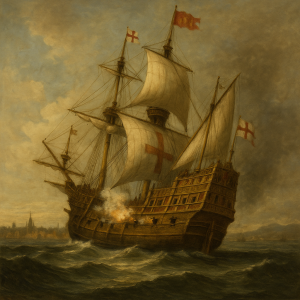
Few artefacts bring us closer to Tudor England than the Mary Rose, Henry VIII’s beloved warship. Launched in 1511, she was a proud symbol of the king’s naval ambitions, built in the Portsmouth dockyards to guard the Channel and project English power overseas. With her towering forecastle, bristling guns, and bold carving, she was both weapon and theatre — a floating declaration that England had entered the age of gunpowder navies.
For over thirty years, the Mary Rose served faithfully in campaigns against France and Scotland. Her decks saw the daily routines of sailors, soldiers, and gunners; her holds carried longbows, pikes, barrels of salted beef, and casks of beer. She was repeatedly refitted as naval technology advanced, shifting from a high-castled carrack towards sleeker lines that foreshadowed the galleon.
Her fate, however, was sealed on 19 July 1545, during the Battle of the Solent. With Henry himself watching from Southsea Castle, the Mary Rose heeled in the wind as she manoeuvred against the French fleet. Accounts suggest she fired a broadside, turned too sharply, and took on water through her open gunports. Within minutes, the pride of the Tudor navy sank beneath the waves, carrying with her over 400 men.
For centuries, she lay buried in silt until rediscovered and raised in 1982 in one of the most ambitious maritime salvage operations ever attempted. Today, preserved at Portsmouth Historic Dockyard, the Mary Rose offers an unparalleled window into Tudor life. Thousands of artefacts — from shoes and combs to musical instruments and longbows — survived in the mud, giving us not just a warship but an entire community, frozen in time.
To stand before her timbers is to confront both the grandeur and the fragility of Tudor ambition. The Mary Rose was Henry’s pride, his navy’s flagship, and in her loss and rediscovery, she has become a national treasure, telling stories far beyond the sea battle that claimed her.
If you enjoy these images, feel free to print them out. In my book. out in October, I have left blank pages for you to paste them in, as a personal reflection or a memory of your journey through Tudor England.
Thank you for reading my posts
Gemma
The Past is Never Silent
www.murderinthetower.london