Meet the characters in my novel: Edward Seymour
26th May 2026 by | Uncategorized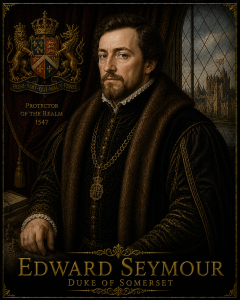
Meet the characters in my novel:The Wolf of Whitehall
Edward Seymour
Power, once held, must be maintained.
For Edward Seymour, that truth defined his place in the reign of Edward VI.
As the king’s uncle, Seymour rose swiftly following the death of Henry VIII, assuming the role of Lord Protector in 1547. In doing so, he did not simply serve the crown — he governed in its name.
His authority was considerable.
Measured in title, reinforced by position, and sustained through the machinery of state, Seymour stood at the centre of power during Edward’s minority. His rule sought to guide England through a period of religious and political change, continuing the movement toward Protestant reform.
Yet authority, once concentrated, invites challenge.
Seymour’s leadership, though initially secure, began to falter under the weight of opposition — both from those who questioned his decisions and from those who sought power for themselves. In a court where influence was never fixed, his position became increasingly exposed.
In 1549, he fell from power.
Within three years, he would be executed.
His rise had been swift.
His fall, inevitable.
Edward Seymour is often remembered as Protector.
But his story is one of something more enduring.
The burden of power — and the cost of holding it alone.
The Wolf of Whitehall
www.amazon.co.uk/dp/B0GWD8P3VC
Author Gemma Morris-Conway
Blog: www.murderinthetower.london
#PrincesInTheTower
#RichardIII
#TudorHistory
Power, once held, must be maintained.
For Edward Seymour, that truth defined his place in the reign of Edward VI.
As the king’s uncle, Seymour rose swiftly following the death of Henry VIII, assuming the role of Lord Protector in 1547. In doing so, he did not simply serve the crown — he governed in its name.
His authority was considerable.
Measured in title, reinforced by position, and sustained through the machinery of state, Seymour stood at the centre of power during Edward’s minority. His rule sought to guide England through a period of religious and political change, continuing the movement toward Protestant reform.
Yet authority, once concentrated, invites challenge.
Seymour’s leadership, though initially secure, began to falter under the weight of opposition — both from those who questioned his decisions and from those who sought power for themselves. In a court where influence was never fixed, his position became increasingly exposed.
In 1549, he fell from power.
Within three years, he would be executed.
His rise had been swift.
His fall, inevitable.
Edward Seymour is often remembered as Protector.
But his story is one of something more enduring.
The burden of power — and the cost of holding it alone.
The Wolf of Whitehall
www.amazon.co.uk/dp/B0GWD8P3VC
Author Gemma Morris-Conway
Blog: www.murderinthetower.london
#PrincesInTheTower
#RichardIII
#TudorHistory