Tutankhamun – Death of a Boy King
24th March 2026 by | Uncategorized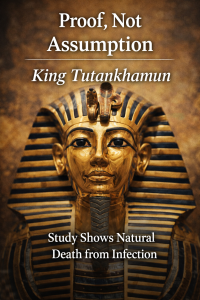
Tutankhamun – Death of a Boy King
The death of Tutankhamun has long been surrounded by theories of murder and conspiracy.
Early examinations, particularly following the discovery of his tomb in 1922 by Howard Carter, fuelled speculation. A fracture in the skull led some to suggest a violent blow — perhaps an assassination within the royal court.
However, modern science has transformed our understanding.
In 2005, CT scans of the mummy revealed that the skull damage occurred after death, likely during the embalming process or later handling. This effectively dismissed the long-standing murder theory.
Further research, including DNA analysis published in 2010, uncovered more compelling evidence:
Tutankhamun suffered from multiple genetic conditions, likely due to royal intermarriage within the 18th Dynasty.
He had a club foot and significant physical impairment — over 100 walking sticks were found in his tomb, suggesting he relied on them in life.
DNA evidence confirmed infection with malaria, a potentially fatal illness in ancient Egypt.
A severe fracture to his left leg, sustained shortly before death, may have led to infection or complications.
Taken together, historians and medical experts now believe his death was the result of natural causes compounded by injury and illness, rather than foul play.
The dramatic narrative of a murdered boy king has, over time, given way to something far more human — a physically fragile young ruler, likely around 18 or 19 years old, whose life was shaped as much by illness as by kingship.
It is a powerful reminder that history, when re-examined through modern science, often replaces legend with truth — not always more dramatic, but far more revealing.
Do connect with me via LinkedIn and or Instagram:
Thank you for reading my posts.
Gemma
www.murderinthetower.london
Author: The Reflection in the Mirror (all 5-star rated on Amazon)