What would this jewel have been worth in 1518?
9th March 2026 by | Uncategorized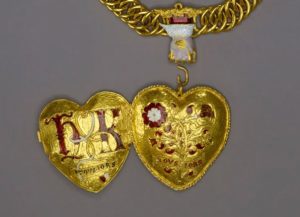
What would this jewel have been worth in 1518?
The extraordinary Tudor heart jewel recently acquired by the British Museum is not only beautiful, but it would also have represented a remarkable fortune when it was made.
In the early sixteenth century, gold was not priced and traded as it is today through global markets. Its value was understood in terms of weight, craftsmanship, and symbolism.
This particular jewel weighs roughly 300 grams of high-purity gold and is decorated with enamel, rubies, and pearls. The workmanship alone would have required the skills of one of the finest goldsmiths working for the Tudor court.
In 1518, such an object would have represented an extraordinary sum of money.
To put that into perspective, a skilled craftsman in Tudor England might earn £5 to £10 a year, while a prosperous gentleman’s household might operate on £20 to £40 annually.
A jewel of this quality, made for the royal court and associated with Henry VIII and Katherine of Aragon, could easily have represented wealth comparable to the value of a modest manor house or small landed estate.
Which raises an intriguing question.
How did such a jewel, something that once symbolised royal love and Tudor power — end up buried in a field in Warwickshire?
That mystery is exactly what has captured my imagination and inspired me to begin researching the story behind this remarkable object.
Do connect with me via LinkedIn and or Instagram:
Thank you for reading my posts.
Gemma
Author: The Reflection in the Mirror www.amazon.co.uk/dp/B0G4SLZ4T7
&
The Wolf of Whitehall( To be published April 2026 )
The past is never silent.
www.murderinthetower.london