JACK CADE AND THE REBELLION OF 1450
11th August 2026 by | Uncategorized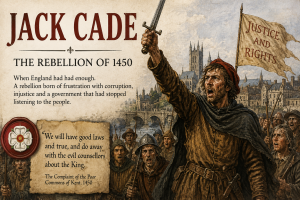
Periods of unrest are nothing new in England.
In the summer of 1450, frustration with government, corruption and the state of the country erupted into one of the most extraordinary popular rebellions of medieval England.
At its head was a mysterious man named Jack Cade.
England was ruled by Henry VI. The war in France was going disastrously, the Crown’s finances were in difficulty and there was widespread anger at corruption and the influence of those surrounding the King.
Cade and his followers did not initially present themselves as men wishing to overthrow the monarchy. They claimed loyalty to Henry VI while demanding reform.
Their grievances make fascinating reading today. They complained of corrupt officials, abuses of justice, excessive influence by the King’s advisers and a government which, in their eyes, had ceased to listen to the people it governed.
Thousands rallied to Cade’s cause, particularly from Kent and the south-east.
The rebels gathered at Blackheath and, after defeating a royal force near Sevenoaks, advanced upon London.
For a brief and extraordinary moment, Jack Cade became master of the capital.
Entering London in July 1450, tradition records that he struck the ancient London Stone with his sword and proclaimed himself ‘Lord of this city’.
But what had begun as an organised demand for reform quickly became darker.
Officials associated with the hated government were seized and executed. Property was looted. Londoners who had initially sympathised with some of the rebels’ complaints began to turn against them.
Fierce fighting followed on London Bridge.
The rebellion collapsed, pardons were offered, and Cade fled.
And this is where the story acquires a fascinating connection with a place that still bears his name.
Near Heathfield in East Sussex is Cade Street, where a monument records the long local tradition that Jack Cade was finally confronted by Alexander Iden, Sheriff of Kent, in July 1450.
Cade was mortally wounded and died before he could be brought back to London. His body was subsequently subjected to the gruesome punishment reserved for a traitor, and his head was displayed on London Bridge.
The precise location of his final confrontation has been debated by historians, but the association between Cade and Heathfield has endured for centuries. His name quite literally remains upon the landscape.
Jack Cade’s rebellion ultimately failed.
Yet the grievances that produced it did not simply disappear, and England was already moving towards the political turmoil that we now know as the Wars of the Roses.
Nearly six centuries later, Cade remains a fascinating and ambiguous character.
Was he a dangerous rebel who allowed legitimate protest to descend into violence?
Or was he the spokesman for ordinary people who believed that those governing England had simply stopped listening?
Perhaps, as so often in history, he was a little of both.
What do you think: rebel, opportunist — or reformer?
Gemma Morris-Conway
Author & Historian